
Receiving Federal grant awards is imperative to the effective administration of VR programs as Federal funding may account for approximately 78.7% of a state’s overall VR budget. Not only can this funding be used for indirect expenditures, such as the salaries for administrative and clerical staff, but it may also be used for direct expenditures that are critical to the mission of serving those with the greatest barriers to employment.
Understanding the basic elements of Federal funding is important because, in the event that funding is used inappropriately, VR agencies may be subject to sanctions as outlined in 2 CFR § 200.339.
The following are important basic concepts to understand regarding grant award issuance:
President's Budget
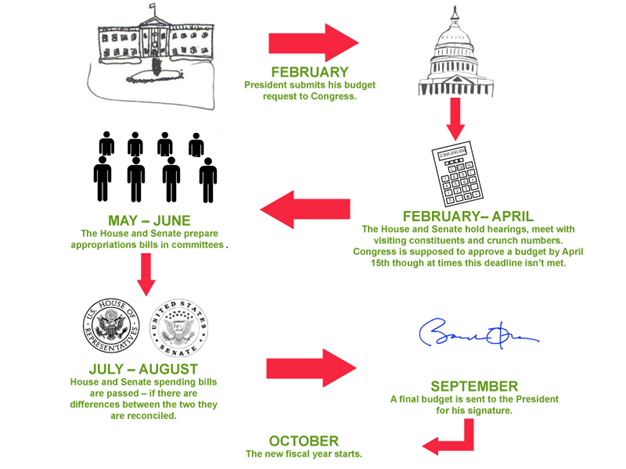
The President initiates the annual budget cycle with the submission of an annual budget proposal for the upcoming fiscal year to Congress. The President is required to submit the annual budget on or before the first Monday in February. However, Congress has provided deadline extensions both statutorily and, sometimes, informally.
The President recommends spending levels for various programs and agencies of the Federal government in the form of budget authority (BA). Such authority does not represent cash provided to or reserved for agencies. Instead, the term refers to authority provided by Federal law to enter into contracts or other financial obligations that will result in immediate or future expenditures (or outlays) involving Federal government funds. Most appropriations are a form of BA that also provides the legal authority to make the subsequent payments from the Treasury. See The Congressional Appropriations Process: An Introduction | Congress.gov.
The U.S. Department of Education posts the budget tables from the President’s Budget on the Department’s website. These are recommendations that are not representative of the funds agencies will receive. Do not view these as a hard line for budget planning.
Budget Resolution
The budget resolution is Congress’s response to the President’s budget. It is a concurrent resolution because it is an agreement between the House and Senate that establishes overall budgetary and fiscal policy to be carried out through subsequent legislation. The budget resolution must cover at least five fiscal years: the upcoming fiscal year (referred to as the “budget year”) plus the four subsequent years.
The budget resolution is not sent to the President and does not become law. It does not provide budget authority or raise or lower revenues; instead, it is a guide for the House and Senate as they consider various budget-related bills, including appropriations and tax measures.
Law establishes April 15 as the target date for congressional adoption of the budget resolution. Since FFY 1977, Congress has frequently not met this target date. In recent years, Congress often did not adopt a budget resolution.
There is no penalty if the budget resolution is not completed before April 15, or not at all.
Appropriation Measures
When considering appropriations measures, Congress exercises the power granted to it under the Constitution, which states, “No money shall be drawn from the Treasury, but in Consequence of Appropriations made by Law.”
The Antideficiency Act explicitly prohibits Federal government employees and officers from making contracts or other obligations in advance or in excess of an appropriation, unless authorized by law, and providing administrative and criminal sanctions for those who violate the act.
Under law, public funds may be used only for the purpose(s) for which Congress appropriated funds.
The timing of the various stages of the appropriations process tends to vary from year to year.
The Senate appropriations Committee typically begins reporting the bills in June and generally completes the committee consideration prior to the August recess. The Senate typically begins floor consideration of the bills beginning in June or July.
Conference Action
Once the House and Senate have both completed initial consideration of an appropriations measure, the Appropriations Committees in each chamber will endeavor to negotiate a resolution of the difference between their respective versions. The practice has generally been for the House and Senate to convene a conference committee to resolve differences between the chambers on appropriations bills. Alternatively, agreement may be reached through an exchange of amendments between the houses.
Regular appropriations bills contain a series of unnumbered paragraphs with headings, generally reflecting a unique budget account. Under these measures, funding for each department and large independent agency is organized in one or several accounts. Each account generally includes similar programs, projects, or items, such as a salaries and expenses account, although a few accounts include only a single program, project, or item.
Presidential Action
Under the Constitution, after a measure is presented to the President, the President has 10 days to sign or veto the measure. If the President takes no action, the bill automatically becomes law at the end of the 10-day period if Congress is in session. Conversely, if the President takes no action when Congress has adjourned, the President may pocket veto the bill.
Continuing Resolution
In general, budget authority provided in regular appropriations expires at the end of the FFY, September 30, unless otherwise specified. If action on one or more regular appropriations measures has not been completed by the start of the FFY, on October 1, the agencies funded by these bills must cease non-excepted activities due to lack of budget authority.
Continuing resolutions (CR) maintain the pre-existing appropriations at the same levels as the previous fiscal year (or with minor modifications) for a set amount of time. CRs typically provide temporary funding until a specific date or until the enactment of the applicable regular appropriations acts, if earlier. Once an initial CR becomes law, subsequent interim CRs may be used to make additional funds available.
In the event that Congress enacts a regular appropriation after a CR, the annual formula award amount to be received by each grantee will be calculated based upon the amount of the appropriation. Then, the total amount of funds awarded to the grantee through previous CRs will be subtracted from the annual formula award amount to determine the remaining balance due the grantee. This is important for fiscal planning purposes in the event there are multiple CRs and Congress enacts an appropriation at a funding level less than the previous FFY on which the CRs were based.
Mandatory Spending
Mandatory spending is composed of budget outlays controlled by laws other than appropriation acts, including Federal spending on entitlement programs.
As a mandatory program, the VR program’s annual spending authority is generally increased by the Consumer Price Index for all Urban Consumers percentage. However, the final total spending authority amount can be affected by Congressional action (e.g., sequestration).
It is important to understand the budget process because it affects:
- The amount of funds each grantee receives;
- When RSA can provide information to grantees regarding grant award amounts for a FFY;
- The timeframe in which the initial and, if necessary, subsequent grant awards may be issued; and
- The number of grant award supplements a grantee receives.
Grant Award Issuance
RSA’s grant award internal controls are contained in Standard Operating Procedures developed in accordance with Department policies that are updated at least annually and approved by the Department’s Risk Management Services
VR Award Formula Variables
The Rehabilitation Act, as amended, sets out a formula for distributing VR grants to states and territories. Through this formula, a portion of the funds appropriated for the VR program are distributed to states based upon the grant allotment they received for fiscal year 1978. States’ 1978 allotments served to ensure that no state experienced a funding decrease when the formula was revised through a 1978 amendment to the Rehabilitation Act. Of the remainder of the funds, one-half is distributed based upon states’ general population and a factor that compares their per capita income to the national per capita income, and the other one-half, according to their population and the square of the per capita income factor. The larger a state’s population, the more funds it will receive. Conversely, the higher a state’s per capita income compared to the national level, the lower its allotment will be. The squaring of per capita income increases its influence on a state’s allotment. However, the formula mitigates the effect of per capita income for states with very high or very low per capita income levels by setting upper and lower limits. Ultimately, the final allotment for a state cannot be less than one-third of 1% of the total amount appropriated, or $3 million, whichever is greater. In Federal fiscal year 2020, the minimum allotment was approximately $11 million.
Per Capita Income: The three-year average per capita income (PCI) average is calculated using the three most recent years of PCI data (available from the U.S. Department of Commerce, Bureau of Economic Analysis) that meet the requirements in Section 8(a)(2) of the Rehabilitation Act. PCI data is updated on each even-numbered year.
Population: Updated annually and is furnished by the U.S. Department of Commerce, Bureau of the Census by October 1 of the year preceding the fiscal year for which funds are appropriated.
When there are two VR agencies, the state is responsible for providing RSA with the percentage of the state’s VR and Supported Employment allotment that is to be awarded to each agency. Upon receipt of the state’s percentages, RSA will continue to allot Federal VR and Supported Employment funds to each agency until such time as the state submits a formal request to change the allotment percentage(s).
Issuance Time Frame
Generally speaking:
- Due to factors both within and outside the control of RSA, the agency works to issue grant awards or supplements within three to four weeks after the funds are made available; and
- If there is a short-term CR that would expire before RSA could issue the funds, the short-term CR funds are combined with the subsequent CR.
G6
G6, which can be accessed at g6.ed.gov, is the Department’s grant management system from which the following is entered and tracked:
- Grant award amounts for the initial grants are entered into G6 manually and verified by RSA fiscal unit staff employing a clear separation of duties;
- Federal Awardee Performance and Integrity Information System (FAPIIS) checks are completed;
- Unique Entity Identifier (UEI) information is verified;
- Specific Conditions or High-Risk Status language is added to the grant awards as needed;
- Grant Award Notifications (GAN) are created and signed electronically; and
- Grant awards are obligated and the GAN email is sent to grantees.
Note: List is not exhaustive.